
August 29, 2026
Franchising Toward 2030: Build a Model That Can Change Without Losing Control
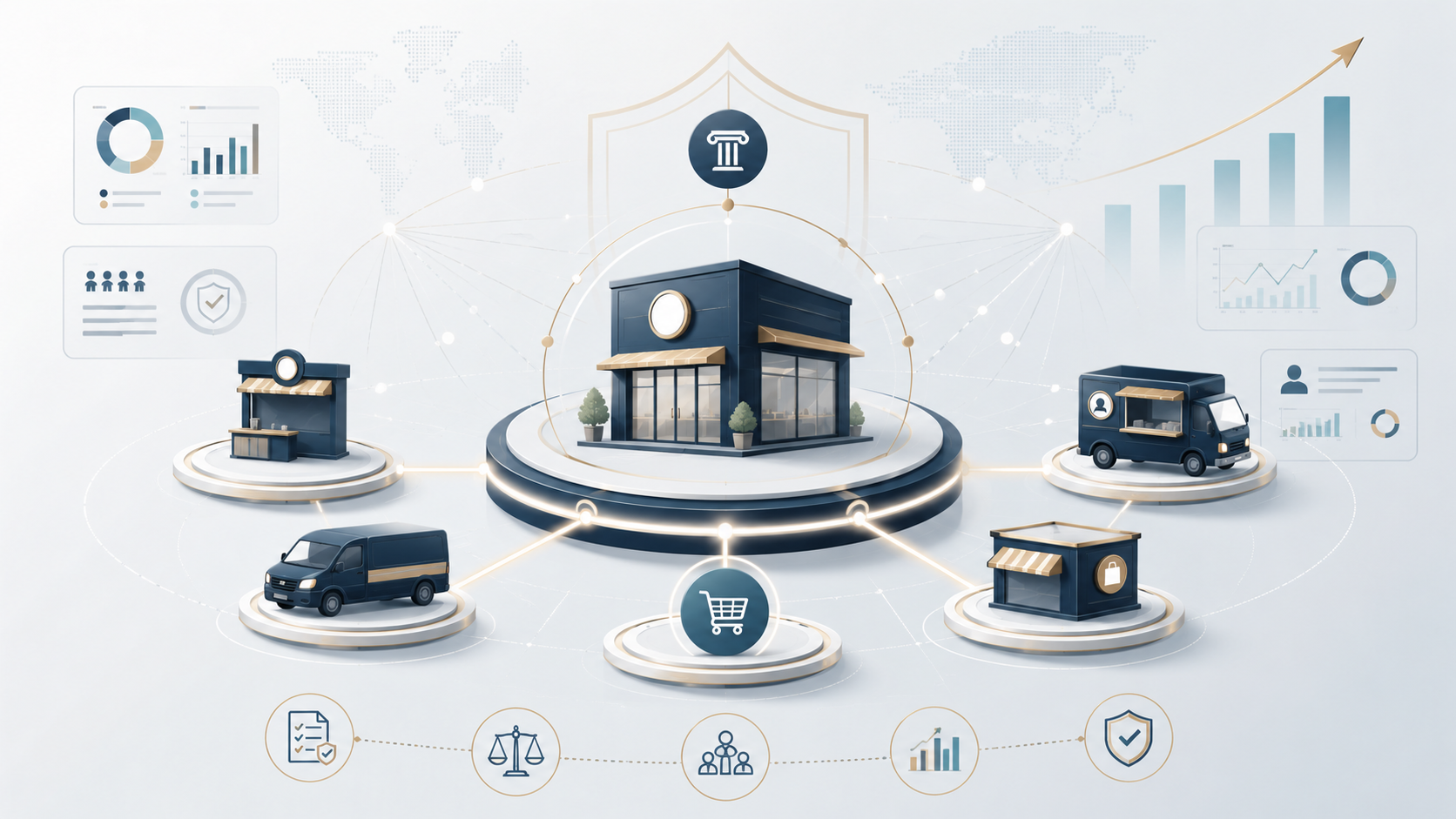
The next phase of franchising will be shaped less by the number of outlets a brand can open and more by how well its commercial model can adapt to changing technology, customer behaviour and operating costs.
Franchising has traditionally been built around repeatability. A successful format is documented, licensed and reproduced by independent operators in new locations. That principle will remain important, but the format being repeated is changing. Physical outlets are increasingly connected to digital ordering, central platforms, customer data, automated systems and multiple routes to market.
For franchisors, the question is no longer simply whether the current model can be replicated. It is whether the model can absorb new technology, different operating formats and changing investment requirements without weakening the economics for the operator or the control needed to protect the brand.
The Franchise Model Is Becoming a Business System, Not Just a Store Format
A future-ready franchise should be designed around the complete operating system. Premises, staff and equipment still matter in many sectors, but so do software, online ordering, digital marketing, customer databases, delivery channels, payment systems and central reporting. Each element can affect how the franchisee earns revenue and how the franchisor manages the network.
This changes the way expansion should be planned. A concept that performs well in one physical format may not transfer neatly into another market where customers buy differently or where property and labour costs alter the economics. Before granting wider rights, franchisors should understand which parts of the model must remain standard and which parts can be adapted without changing the brand proposition.
Technology Must Earn Its Place in the Unit Economics
Artificial intelligence, automation and data tools can improve forecasting, customer service, inventory control, marketing and operational reporting. But the commercial value of technology depends on what it changes at unit level. A new system that improves visibility for the franchisor but creates significant recurring costs for the franchisee may be difficult to sustain across a large network.
Technology planning should therefore be connected to the financial model. The parties need clarity on who pays for software licences, hardware, upgrades, integration, training and replacement systems. They should also understand whether new technology reduces labour requirements, improves conversion, lowers waste or creates another fixed cost. The objective is not to adopt technology because it is available. It is to use it where the economics and operating case are clear.
Digital Sales Rewrite Territory and Customer Ownership
Territory was easier to understand when customers mainly purchased from the nearest physical outlet. Digital channels make that assumption less reliable. A customer may live inside one franchisee's territory, order through a central brand website and receive the product from another location. A national campaign may generate leads across several territories at the same time.
That makes channel design a commercial issue, not simply a drafting issue. Franchisors should decide how online leads, delivery orders, central accounts, marketplaces and platform sales fit into the network before expansion creates competing expectations. The allocation of revenue, fulfilment responsibility, marketing cost and customer data should follow a consistent commercial logic. Unclear channel rules can weaken trust even where the physical territory itself is clearly defined.
Growth Will Need More Than One Operating Format
By 2030, many franchise networks may use a mix of full-format locations, smaller outlets, kiosks, delivery-focused operations, mobile services, home-based models or digital-only offerings. Not every brand will use all of these formats, but relying on a single route to market can limit flexibility when customer behaviour or property economics change.
Different formats also require different investment assumptions. A smaller footprint may reduce rent and fit-out costs but increase dependence on delivery platforms or central technology. A digital model may scale faster but require stronger systems for customer acquisition, data access and service quality. Franchisors should assess each format as its own business case rather than treating it as a cheaper version of the original model.
Governance Has to Be Designed for Change
A network becomes harder to manage when the business changes faster than its decision-making structure. Franchisors need a practical process for introducing new systems, changing operating standards, testing new channels and responding to franchisee feedback. Franchisees, in turn, need enough visibility to understand why a change is being made and what investment or operational impact it may create.
Good governance does not mean giving every operator control over network strategy. It means defining how important changes are assessed, communicated and implemented. Pilot programmes, clear reporting, structured consultation and measurable performance data can make network decisions easier to evaluate. They can also reduce the risk of turning every operational change into a disagreement about control.
A franchise model built for the next decade may not be the one with the most technology. It may be the one that can change without repeatedly destabilising its operators. For brands planning international or multi-market growth, that requires a clear view of unit economics, technology costs, channel rights, investment responsibilities, operating formats and the limits of local adaptation before expansion locks in expectations that are difficult to change.
Kaden Boriss advises businesses on franchise structuring, commercial strategy, market entry and cross-border expansion. Consult with the Kaden Boriss team to assess whether your franchise model is built for the next stage of growth.
FAQs
1. How should a franchisor prepare its model for 2030?
The focus should be on adaptability. Review unit economics, technology costs, sales channels, territory rules, reporting systems and future investment requirements so the network can change without creating uncertainty for operators.
2. Will physical franchise outlets disappear?
No. Physical locations will remain important in many sectors. The larger change is that more franchise networks are likely to combine physical locations with digital ordering, delivery, smaller formats and other routes to market.
3. Should every franchise adopt AI and automation?
No. Technology should have a clear operating or financial purpose. Franchisors should assess what a system improves, what it costs to introduce and maintain, and how those costs affect franchisee economics.
4. Why do digital channels affect franchise territory?
Digital sales can cross physical boundaries. Online orders, delivery platforms, central accounts and digital marketing can create uncertainty over revenue, fulfilment, customer ownership and marketing responsibility if channel rules are not defined clearly.
5. Can different franchise formats use the same financial model?
No. A full-size outlet, kiosk, delivery-focused operation and digital model can have very different cost structures. Each format should be tested on its own investment requirements, revenue model and operating assumptions.
6. What should be reviewed before expanding a franchise internationally?
The commercial model should be tested against local customer behaviour, property costs, staffing, supply arrangements, technology requirements, investment capacity and the level of adaptation needed in the new market.
Published 29 August 2026